How to Color Spooky Halloween Pages: Shading & Glow Tips
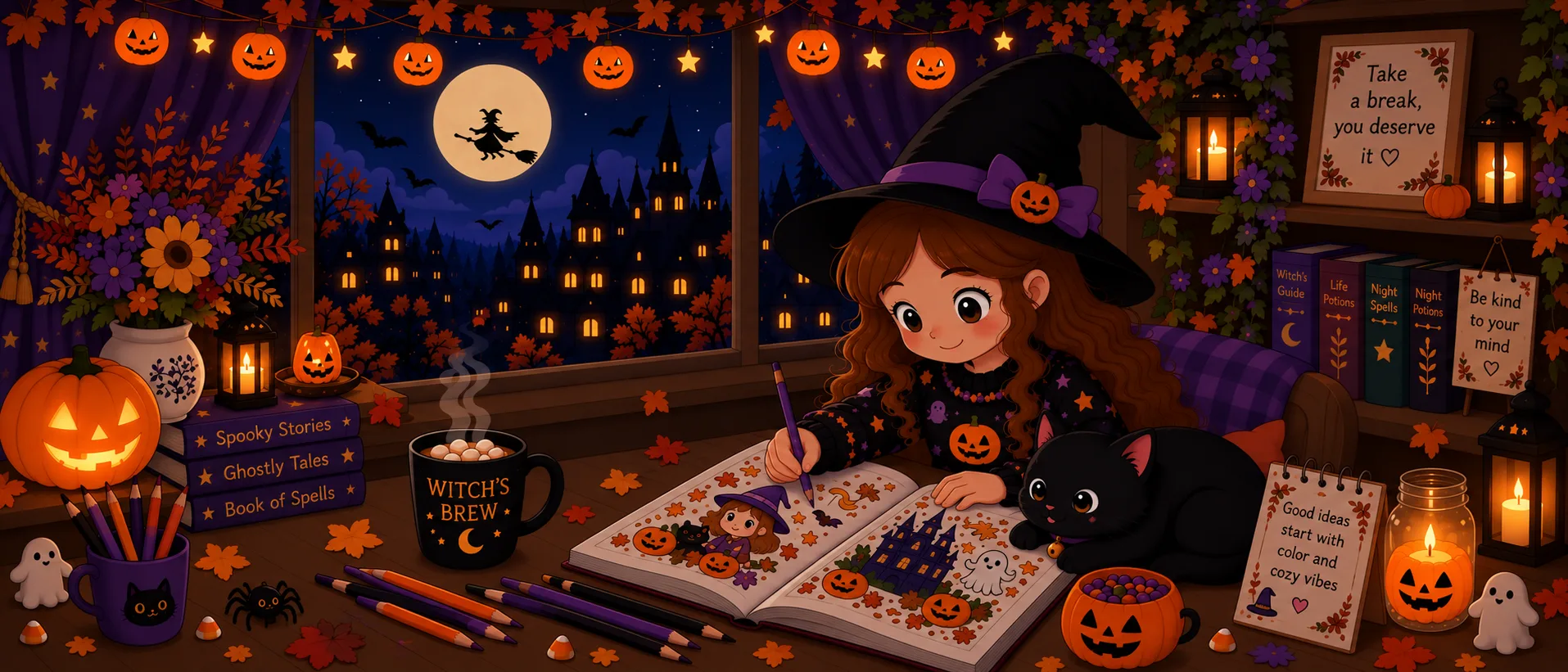
Cute Halloween pages are easy to color — a few oranges, a black cat, done. Getting that cozy-spooky atmosphere — glowing windows, deep shadows, candlelight that actually looks like it's glowing — takes a few extra technique tweaks. These tips work on any Halloween coloring page, from a simple pumpkin to the moodier, detail-heavy scenes in a book like Spooky Scenes.
What Colors Work Best for Spooky Halloween Pages?
Skip the bright primary colors and lean into deep purples, burnt orange, warm mustard yellow and inky black-blue instead of true black. Pick one or two warm "light source" colors — the glow in a window, a jack-o'-lantern's face — and let everything else sit a shade or two cooler and darker around it. That contrast between one warm glow and a cooler, dimmer surrounding is most of what reads as "spooky" rather than "flat."
- ♥Base shadows: deep purple, indigo or navy instead of plain black
- ♥Warm glow: pale yellow fading to orange or amber
- ♥Accent: a single saturated color (blood orange, deep red, or violet) used sparingly
- ♥Night sky: blue-black or purple-black, never pure black — it keeps depth
Layer Your Shadows Instead of Flat Black
For dark areas — the inside of a cauldron, the shadow under a porch roof, a cat's fur — build up gradually instead of reaching straight for black. Start with a light layer of dark purple or navy, add a second layer to deepen it, and only bring in black (or a very dark brown) for the deepest pockets, like right under an object or inside a doorway. Flat black can look like a hole in the page; layered dark tones still read as dark but keep texture and depth.
Make Light Sources Actually Glow
For a candle flame, a lit window or a jack-o'-lantern's grin, color the light source itself first in pale yellow or white, leaving a tiny uncolored highlight at the brightest point. Then work outward with orange, blending so the color gets warmer and slightly darker the further it gets from the source, fading into the surrounding shadow color instead of stopping at a hard edge. That soft gradient — pale center, warm middle, dark edge — is what sells "glowing" over "colored in orange."
Add Texture to Fur, Fog and Night Skies
Flat color on a black cat or a misty background can look stiff. For fur, use short strokes that follow the direction it would actually grow, varying the pressure so some strokes land darker than others. For a foggy or starry night sky, try light circular motions or stippling instead of solid strokes — it breaks up the flatness and reads as atmosphere rather than a block of color.
Tools That Make Moody Shading Easier
Blendable colored pencils make this kind of gradual, layered shading much easier than a basic set — look for ones described as soft-core or artist-grade rather than student-grade. Alcohol-based markers are the other option if you prefer smoother, faster gradients over pencil layering. Both approaches are covered in more detail here:
7 Best Colored Pencils for Adult Coloring →
Colored Pencils vs Markers: Which Should You Use? →
Practice on a Free Page First
Before committing a full book to a new palette or technique, test it on a single free page — it's a low-stakes way to see how your colors blend and whether your light-source trick is working before you're thirty pages in.
Grab a free Halloween coloring page →
Once you've got the technique down, Spooky Scenes is built for exactly this kind of moody, detail-heavy coloring — 30 atmospheric pages of haunted bookstores, witchy rooms and lantern-lit streets.

Ready for a cozy coloring session?
Explore our printable coloring books, filled with cozy moments and a touch of magic.
Browse Coloring Books→